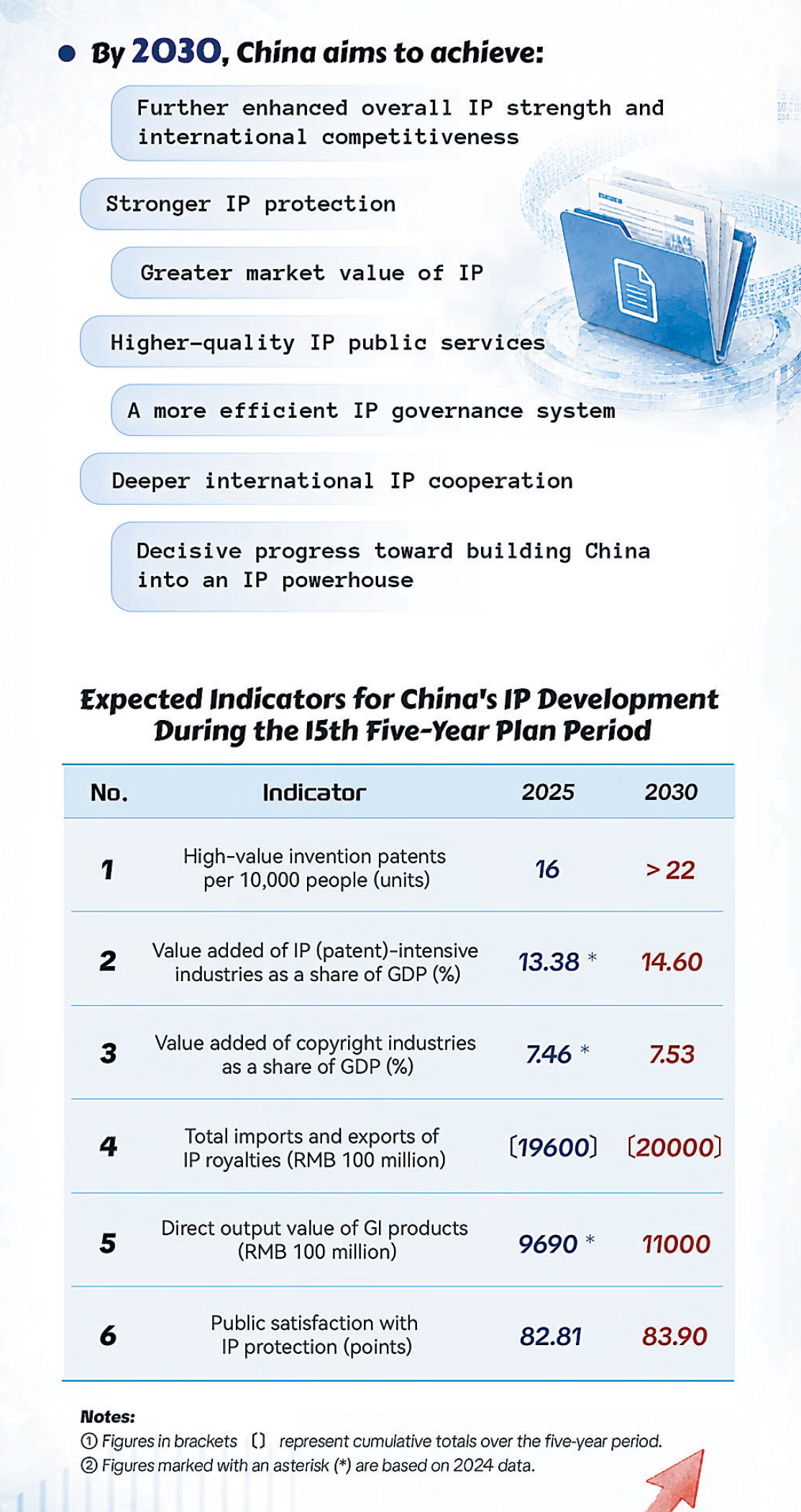
Recently, China's State Council issued the 15th Five-Year Plan (2026-2030) for intellectual property (IP) protection and utilization, setting out strategic goals and outlining key tasks and special projects for IP development over the next five years. What priorities are highlighted in this five-year roadmap? Let's take a closer look at the plan and explore the evolving landscape of China's IP development.
Task 1: Continuously Improving the IP Protection Environment to Support Comprehensive Innovation
Wherever innovation advances, IP protection must keep pace. To improve the IP legal framework, the plan calls for strengthening research on fundamental IP laws and improving systems for IP protection and utilization. It also proposes enhancing IP protection mechanisms in emerging fields and establishing protection rules for specific areas, exploring frameworks for data-related IP protection, and strengthening IP protection in fields such as intangible cultural heritage and traditional Chinese medicine. To further improve the IP protection system, the plan outlines measures to strengthen judicial protection, enhance administrative enforcement, and improve coordinated protection mechanisms. It also calls for stronger foreign-related IP protection, improved capacity to handle international IP disputes, enhanced guidance for enterprises seeking IP protection abroad, and better mechanisms for addressing overseas IP disputes.
Task 2: Enhancing IP Utilization Efficiency to Drive High-Quality Economic Development
IP serves as an important institutional and technological foundation for the development of new quality productive forces. To strengthen the commercialization and utilization of IP, the plan sets out measures to foster a sound ecosystem for IP commercialization and utilization, deepen reforms in IP benefit-sharing mechanisms, and promote the sound development of IP finance. To increase IP support for the development of new quality productive forces, the plan proposes a range of initiatives, including advancing the patent navigation project, establishing and improving specialized databases for international standard-essential patents (SEPs), implementing trademark and brand strategies, and promoting geographical indication (GI) products and brands. These measures aim to enable IP to play a greater role in supporting breakthroughs in key core technologies, empowering industrial innovation, and fostering distinctive economies driven by IP. The plan also calls for promoting the high-quality development of the IP service sector by enhancing IP service capabilities and strengthening regulation of IP services.
Task 3: Building a More Efficient IP Governance System
During the 15th Five-Year Plan period, China will continue to advance IP reforms, with the establishment of a more efficient IP governance system as a key objective. To this end, the plan outlines measures to improve IP administration, strengthen IP public services, and promote broader social participation in IP governance. For example, to improve IP examination and administration, it proposes advancing the development of world-class patent and trademark examination institutions and improving related policies and management systems. To strengthen IP public service capabilities, it proposes enhancing guidance and support for institutions such as Technology and Innovation Support Centers (TISCs), and encouraging qualified overseas service hubs to integrate IP public services. To cultivate IP talent, the plan highlights the need to strengthen the development of international IP colleges and foster high-level national and specialized IP think tanks.
Task 4: Establishing a New Framework for International IP Cooperation to Support High-Standard Opening-Up
IP is an important pillar for China's efforts to build an innovation-driven country and expand opening-up. To participate more deeply in global IP governance, the plan calls for strengthening cooperation within international frameworks and multilateral mechanisms, including the United Nations and the World Trade Organization, and constructively engaging in multilateral affairs of the World Intellectual Property Organization. The plan also proposes promoting the negotiation and conclusion of international agreements containing IP rules related to trade and economic cooperation, as well as agreements on GI protection with more countries and regions. It further highlights the importance of actively researching and participating in the development of international IP rules and standards in emerging areas such as artificial intelligence, big data, and green and low-carbon technologies. To further deepen international IP exchanges and cooperation, the plan calls for advancing high-quality Belt and Road cooperation on IP, expanded bilateral and multilateral IP cooperation with key countries and regions, steady growth in the number of valid overseas invention patents held by Chinese innovators, and broader global expansion of Chinese trademarks, brands, and GI products. It also proposes establishing international IP forums and signature events, as well as further enhancing China's capacity for international IP communication.