Attention! The 33 finalists for the 2026 World Intellectual Property Organization (WIPO) Global Awards have been announced, with six Chinese companies from the environment, health, and information and communication technology (ICT) sectors making the shortlist. Behind their technological breakthroughs and intellectual property (IP) strategies lies a shared story: bringing Chinese innovation to the global stage. Ahead of the announcement of this year's winners, we interview representatives of the six Chinese finalists to explore how Chinese companies are leveraging IP strategies to deepen their integration into the global innovation ecosystem.

Q: What breakthroughs has your company achieved in developing the eco-friendly biomaterial polyhydroxyalkanoate (PHA)?
Xu: PHA is a next-generation sustainable material that is fully bio-based, biodegradable, and low-carbon throughout its lifecycle. Leveraging Halomonas strains identified by researchers at Tsinghua University in the extreme environments of western China, together with the Next-Generation Industrial Biotechnology (NGIB) system, PhaBuilder has enabled the efficient synthesis of PHA materials through open, non-sterile, continuous fermentation processes. This breakthrough effectively addresses challenges such as microbial contamination and limited scalability in conventional biomanufacturing. Built upon Chinese synthetic biology technologies protected by IP rights, our Halomonas chassis strain supports precise metabolic engineering. We continue to explore over 10 billion potential PHA molecular structure combinations and are now capable of producing more than 70 PHA polymers with diverse properties.
Through our "4P" strategy — PHAmily, PHAdustry, PHAbrary, and PHALife — we have established low-carbon, circular biomanufacturing value chains integrating feedstock R&D, intelligent manufacturing, material development and industrial applications. As of the end of 2025, our PHA products had been exported to 20 countries and regions, serving sectors including healthcare, food and beverage, cosmetics and personal care, footwear and apparel.
Q: What IP management system has your company established during its global expansion?
Xu: Being shortlisted among the 33 finalists for the WIPO Global Awards is a strong recognition of our efforts to transform technologies into industrial applications and bring products to market through IP strategies. Centered on microbial strains and genetic engineering, we continue to invest heavily in R&D, with patent filings covering upstream "biochip" technologies accounting for approximately 40% of our entire patent portfolio. We have built a comprehensive IP management system integrating upstream innovation, coordinated management, full value-chain coverage, and ecosystem collaboration. The system features end-to-end patent protection, multi-layered trademark portfolios covering corporate, product, and technology platform brands, and market access supported by international certifications. To date, our company has been granted more than 60 invention patents in China and has filed over 30 international patent applications through the Patent Cooperation Treaty (PCT). We also own 107 registered trademarks worldwide.
Q: What achievements has your company made in innovative drug development in recent years?
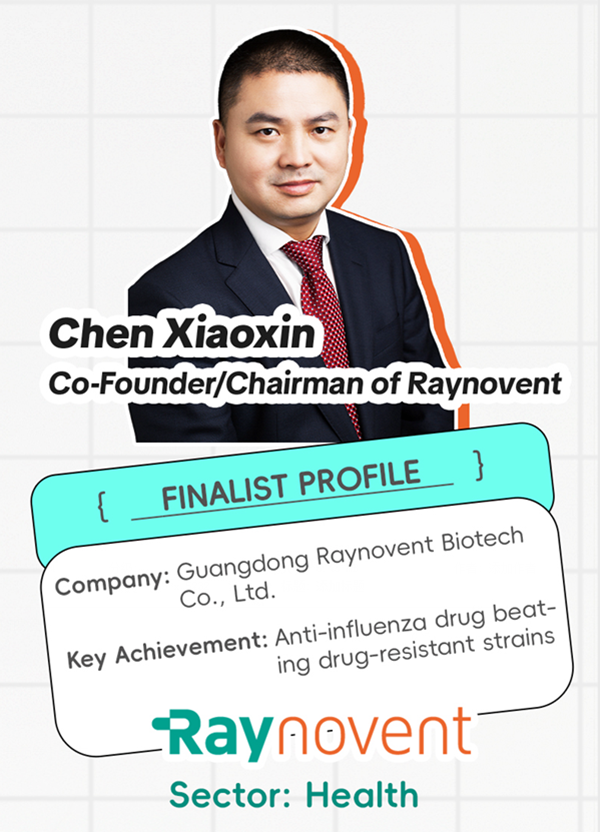
Chen: Raynovent focuses on developing and commercializing innovative therapies for respiratory and metabolic diseases. To date, two Category 1 innovative drugs — Leritrelvir Tablets and Onradivir Tablets — have been approved for marketing. Also, we are actively advancing National Medical Products Administration (NMPA) approval and the commercial launch in China for two key pipeline assets: Onradivir Granule and RAY1225.
Drug-resistant influenza is a global public health challenge. As the world's first approved PB2 inhibitor-based innovative anti-influenza drug, Onradivir Tablets offer advantages including rapid onset, strong efficacy, and a low risk of resistance. By targeting the PB2 subunit, the drug inhibits the "cap-binding" function of influenza A virus RNA polymerase and blocks viral replication at an early stage. Our company is currently accelerating the commercial rollout of Onradivir Tablets and working to advance the product's registration and commercialization in the Macao Special Administrative Region and the Hong Kong Special Administrative Region of China. Since being included in China's National Reimbursement Drug List in 2025, the product has quickly gained traction in major Grade‑A tertiary hospitals nationwide, while being simultaneously deployed across online and offline channels. We are also diversifying into multiple modalities including small-molecule and oligonucleotide therapeutics, to reinforce long-term pipeline supply.
Q: How does your company develop IP strategies throughout the full lifecycle of innovative drug development in global markets?
Chen: Innovative drug development involves long cycles and significant investment. A systematic IP strategy is essential to safeguarding market exclusivity for patented products and supporting continued innovation. From the early stages of project initiation, we develop IP strategies across the entire product lifecycle and continuously align IP management with our business objectives. For core technologies, we prioritize filing PCT international patent applications and tailor overseas patent strategies based on target market demand, patent protection conditions, and other factors. Meanwhile, given the specific requirements for pharmaceutical products, we develop trademark strategies early in the R&D process, covering key product names, logos, and potential co-brands. As of May 2026, our company held 120 granted patents worldwide, as well as 67 registered trademarks.
Q: What technological innovations has Rokid developed in smart glasses, and what are their key advantages?
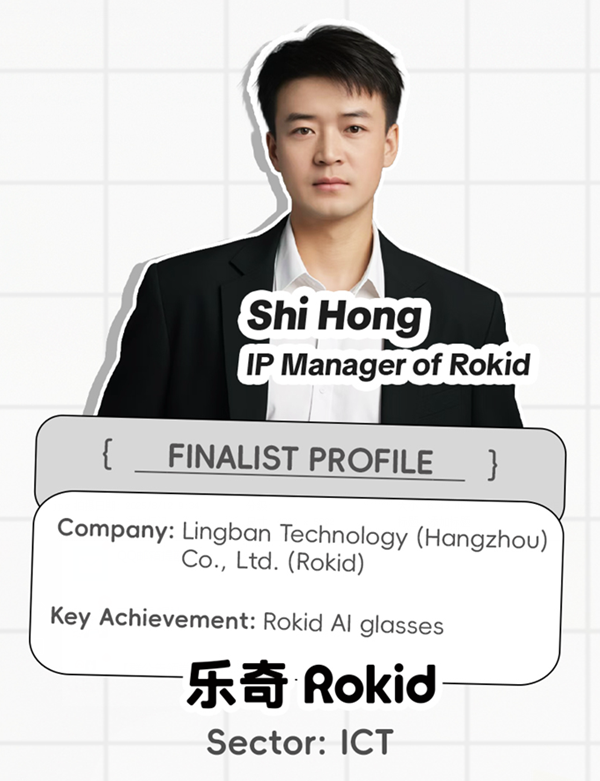
Shi: Since our founding in 2014, Rokid has been dedicated to developing hardware and software for AI/AR smart glasses, as well as building an open ecosystem centered on the YodaOS smart glasses operating system.
Rokid AI glasses are the world's first ultra-light AI glasses that support seamless switching between large AI models. They address a key industry challenge: balancing interactive performance with wearing comfort. Integrating self-developed optical display, AI interaction, and open ecosystem technologies, Rokid AI glasses support a wide range of applications, including real-time translation, navigation, and AI-powered Q&A, while enabling more accessible communication for users including people with visual impairments. Currently, Rokid AI glasses are available in 166 countries and regions worldwide. In 2025, our orders exceeded 350,000 units, including more than 50,000 overseas orders.
Q: How has Rokid built an IP management system tailored to its stage of development?
Shi: Guided by the principle of "IP first," Rokid has established a comprehensive IP protection system covering patents, trademarks, copyrights, and trade secrets. This integrated approach creates a closed-loop mechanism spanning technological strengths, brand assets, content rights, and core confidential information. We continue to expand our global IP portfolio through international mechanisms such as the PCT and the Paris Convention for the Protection of Industrial Property. To date, our company has filed 680 patent applications, including 209 granted invention patents, and has registered more than 430 trademarks across 76 countries and regions. Meanwhile, Rokid places strong emphasis on proactive overseas IP risk management through initiatives such as joining global patent defense alliances and obtaining overseas IP infringement liability insurance to safeguard our international operations. Being named among the 33 finalists of the WIPO Global Awards demonstrates that Rokid has achieved global competitiveness through technological accumulation and IP strategies in AI and AR.