To facilitate the public and trademark agency practitioners in better understanding the Trademark Examination and Adjudication Guideline (hereinafter referred to as "Guideline") and to address public concerns, the Trademark Office of China National Intellectual Property Administration has compiled a set of questions and answers on key issues regarding the formulation of the Guideline.
Chapter 4, Part II of the Guideline is titled "Examination and Adjudication of Distinctive Characteristics of Trademarks". This Chapter revises and supplements the content of the former Trademark Examination and Adjudication Standards (formulated and issued in 2005, first revised in 2016). Relevant interpretations are now provided as follows:
1. Q: Why does the Guideline include an interpretation of the concept related to distinctive characteristics of trademarks?
A: Article 9 of the Trademark Law stipulates that "the trademark applied for registration shall have distinctive characteristics for identification", while Article 11 specifies the signs that lack distinctive characteristics and shall not be registered as trademarks. Distinctive characteristics are the fundamental attributes of a trademark. Trademarks applied for registration must possess distinctive characteristics. The examination and adjudication standards for distinctive characteristics of trademarks need to be constructed on the basis of the concept of a trademark's distinctive characteristics. Drawing on relevant practices and theoretical research, therefore, the Guideline has refined the expression of concepts related to distinctive characteristics of trademarks:
Firstly, the Guideline clarifies that distinctive characteristics of a trademark refer to "the characteristics that a trademark should possess and that are sufficient for the relevant public to distinguish the source of the goods or services". Specifically, it means that "the trademark can enable consumers to identify and remember it, fulfilling the function and role of indicating the source of the goods or services". That is to say, the trademark itself must be easily distinguishable, creating an impression on consumers and retaining that impression in their memory, ultimately serving to distinguish the source of goods or services. For example, overly complex words or devices are difficult for consumers to identify and remember; using them as trademarks cannot fulfill the function of distinguishing the source of goods or services and thus lacks distinctive characteristics.
Secondly, the Guideline explains the meanings of terms related to distinctive characteristics of trademarks mentioned in Article 11 of the Trademark Law, including "only", "the goods", "generic names, devices, or model numbers", "simply indicate", "quality", "main raw materials", "function", "use", "weight", "quantity", and "other features".
Thirdly, the Guideline lists the two ways in which a trademark can acquire distinctive characteristics: inherent distinctiveness and distinctiveness acquired through use.
Clarifying the aforementioned concepts related to distinctive characteristics of trademarks serves a dual purpose. On one hand, it aims to urge trademark examiners to better grasp the connotation and denotation of trademark distinctiveness, more accurately determine whether a trademark possesses distinctiveness and is eligible for registration, thereby ensuring the consistent application of the standards, the correctness of examination conclusions, and the improvement of examination quality. On the other hand, it also reminds applicants to choose signs with stronger distinctive characteristics when applying for trademark registration.
2. Q: How to assess distinctive characteristics of a sign that consists of the full name of an enterprise?
A: Sections 3.3.9 "Organizational Forms of Enterprises, Industry Names or Abbreviations" and 3.3.10 "Signs Consisting Solely of the Full Name of the Applicant (Excluding Natural Persons)" of Chapter 4 stipulate how to assess distinctive characteristics of signs that consist of enterprise names.
Generally speaking, a sign consisting solely of the full name of the applicant (excluding natural persons) lacks requisite distinctive characteristics of a trademark, unless it includes additional elements such as devices, which render the sign distinctive as a whole.
However, it is noteworthy that in recent years, a growing number of public institutions, such as universities, research institutes, hospitals or social organizations, have registered their full names as trademarks. This helps them combat infringement on one hand, and expand the brand value of their names and enhance the utilization of their intangible assets on the other hand. In some cases, the full name of a public institution or other organization has acquired a high degree of recognition through long-term use and has established a direct one-to-one correspondence with that institution or organization in connection with the goods or services on which it is actually used, so that it would not cause confusion or misidentification to consumers and can identify the source of the goods or services. In this circumstance, such name shall be deemed to possess distinctive characteristics of trademarks. Examples include the sign "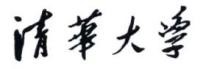 " (Tsinghua University) designated for use on services such as school education and book publishing.
3. Q: Why does the Guideline revise the criteria for determining distinctive characteristics of trademarks containing non-distinctive elements?
A: In practice, however, for trademarks composed of independent devices and words, where the device part possesses a certain degree of distinctiveness while the word part lacks distinctiveness, problems will arise if distinctive characteristics are recognized solely on the basis of the device part. Firstly, this approach contradicts the principle of assessing distinctive characteristics of a trademark as a whole and can easily lead to ambiguity in the scope of trademark protection. Secondly, in reality, some trademark owners have used such trademarks to engage in extortion or initiate bad faith infringement complaints on e-commerce platforms. Thirdly, this standard is also inconsistent with current practices in trademark authorization and confirmation. Relevant administrative or judicial cases concerning trademarks typically hold that for a trademark composed of separate device and word elements, if the word part, which is the dominant verbal element of the trademark, lacks distinctiveness, the trademark as a whole should be deemed to lack distinctive characteristics.
Therefore, following a review of relevant cases, consultation with courts at various levels and scholars and multiple discussions, the Guideline has updated the criteria for determining distinctive characteristics of trademarks containing non-distinctive elements. It clearly states that "if a trademark consists of an independent word part and other independent elements and the word part lacks distinctiveness, the trademark as a whole shall be deemed to lack distinctive characteristics". At the same time, to fully protect the rights and interests of applicants and regulate trademark examination and adjudication practices, the Guideline specifies that "if the other elements possess strong distinctive characteristics and the trademark registration authority considers that there is a possibility of distinguishing the source of goods or services on the basis of these elements, it may issue an examination opinion to the applicant, requiring it to disclaim the exclusive right to the non-distinctive word part. If the applicant does not disclaim or fails to respond to the examination opinion within the specified time limit, the trademark registration application shall be rejected".